This delectable chicken Filipino adobo, the national dish of the Philippines, is super simple to make yet BIG on flavor! In Ebie Guevara’s recipe, chicken is treated to a marinade that perfectly balances savory, tangy, and umami-rich flavors. The adobo marinade reduces to a glaze-y coating over juicy, fall-apart tender chicken. In just 30 minutes, you can whip up a delicious weeknight meal using pantry staples. It’s sure to become a regular in your recipe rotation!
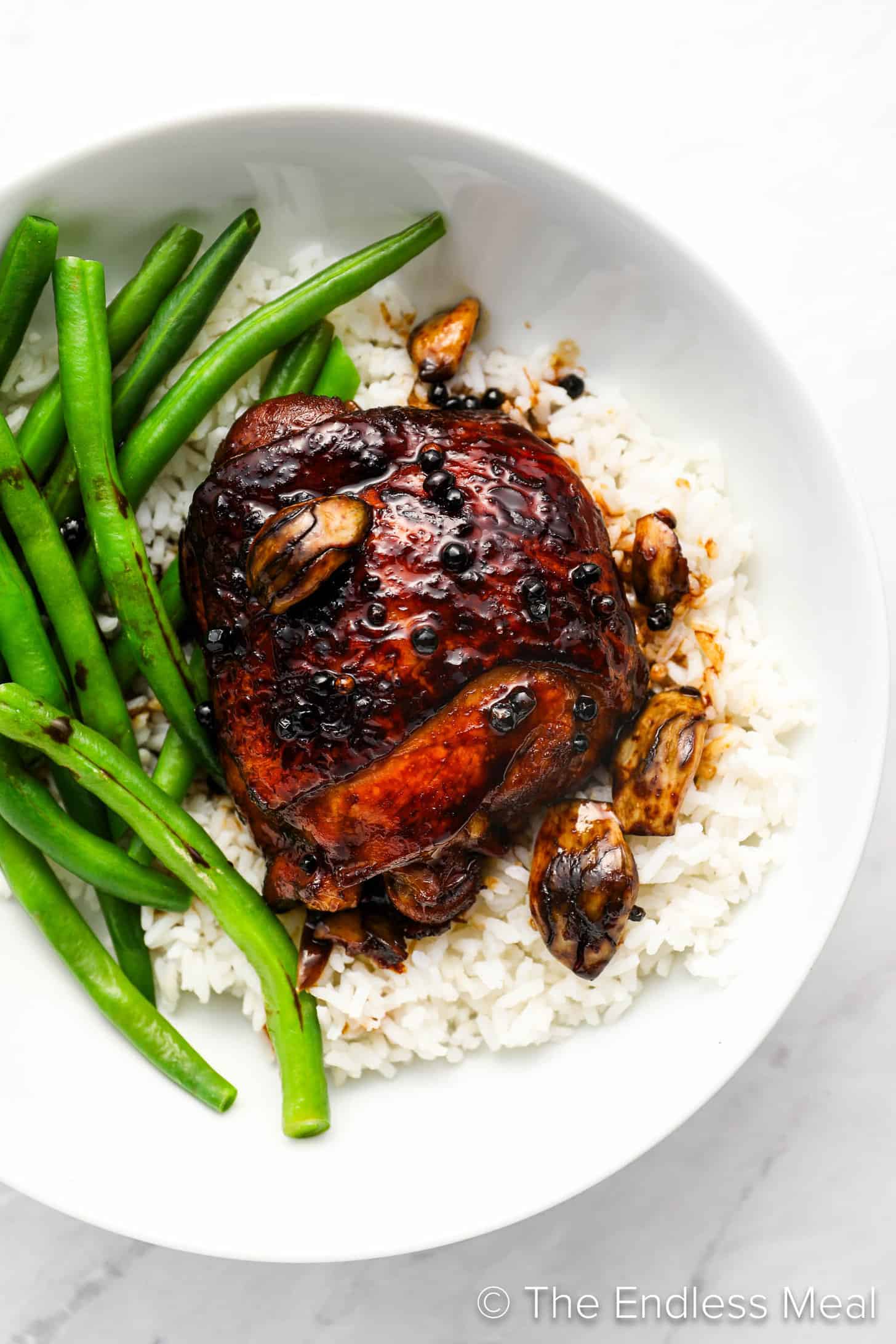
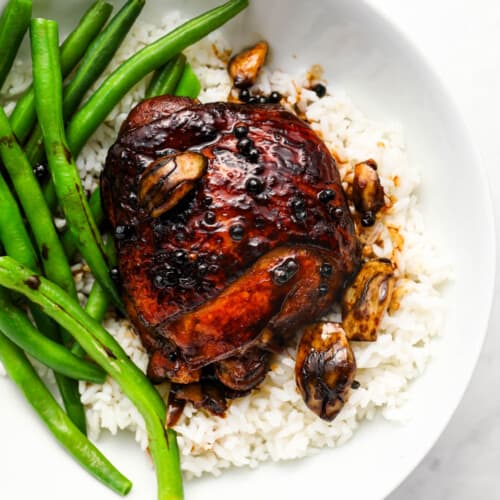
Filipino adobo is considered to be the official national dish of the Philippines as it’s so common and well-loved. Tangy, salty, garlicky, and flavor-packed chicken is served over fluffy and steaming white rice with a side of lightly steamed greens. It’s a crowd-pleaser dish that’s perfect for a busy weeknight, meal prep, or when you’re just craving some savory goodness!
What is Filipino adobo chicken?
Filipino chicken adobo is a beloved dish, iconic of the Philippines. While it may not have officially been given the title of national dish, its widespread popularity makes it an unofficial culinary emblem of the beautiful Philippines!
So, what is it? The word ‘adobo’ comes from the Spanish word “adobar” which translates to ‘to marinate.’ (Don’t get confused with Mexican adobo – they are totally different!) Filipino adobo involves marinating chicken in a flavorful concoction of soy sauce, vinegar, garlic, bay leaves, more garlic, and black peppercorns.
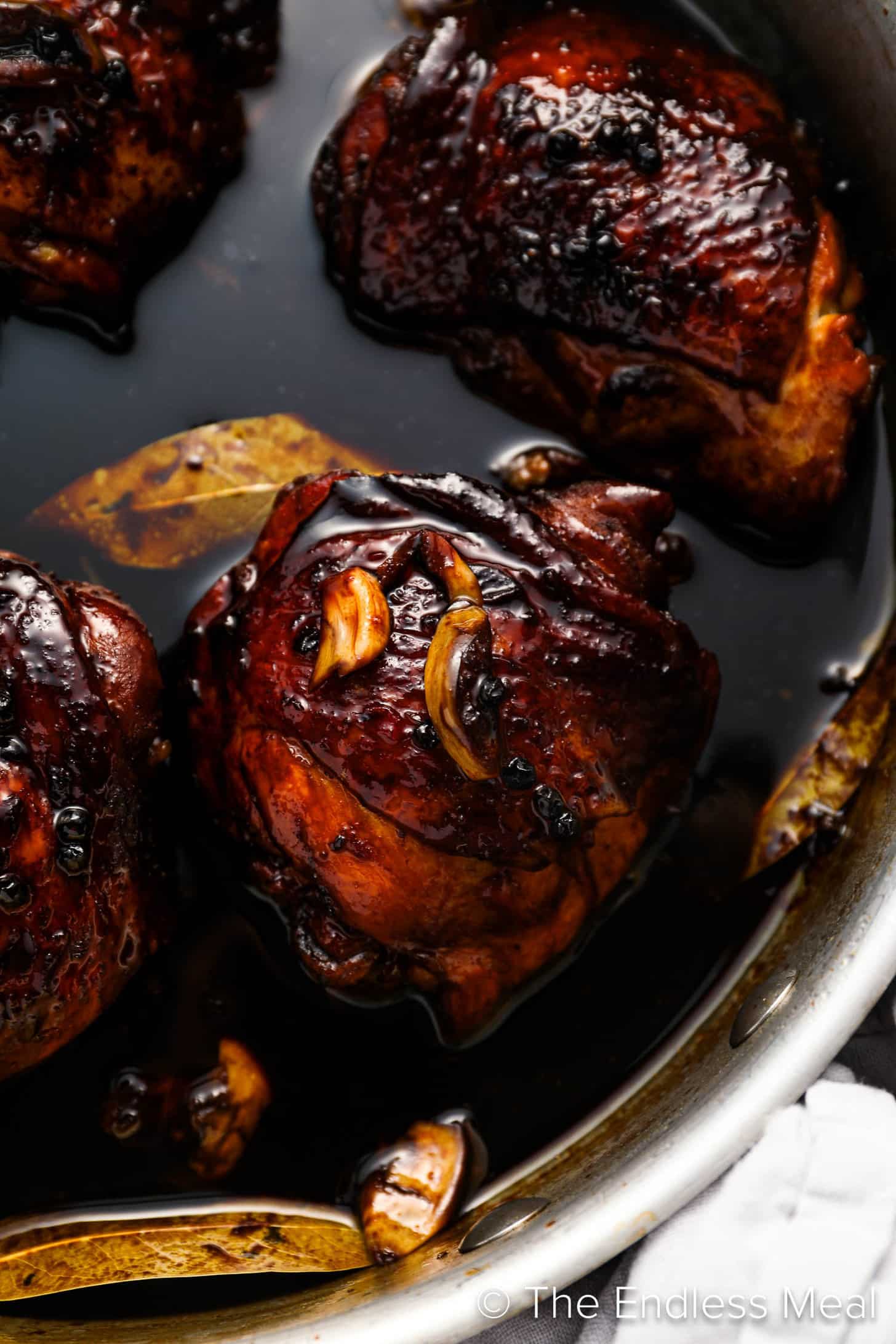
After the meat is left to soak up all the delicious marinade, it’s browned and left to simmer until tender and infused with all the flavors. This creates a savory, subtly tangy, umami-rich flavor that’s almost glazy, but soft rather than sticky.
Is this an authentic Filipino adobo recipe?
Gaile says that this is the chicken adobo recipe she grew up with, the one that her mom, Ebie Guevara, grandmothers, and great-grandmothers made. She told us that her, “mom would usually prep it on Sundays and sometimes marinate it for a couple of days.” She says that “the longer the marinate the more the flavor is infused with garlic.”
One thing to know is that there are likely as many chicken adobo recipes as there are families in the Philippines and abroad. There are many regional variations as well as personal preferences. Some like it more sour, some like it sweetened, and others add coconut milk for a version called adobong manok sa gata . This recipe is Ebie Guevara’s Filipino adobo recipe.
Watch our video to learn how to make Filipino chicken adobo
Subscribe to our channel to watch more cooking videos!
Ingredient notes
Chicken adobo uses under 10 ingredients, many of which you probably already have in the pantry! We love it when something so good is made from such simple ingredients. This is what you need for this Filipino chicken adobo recipe:
- Soy sauce: Try to get an authentic Filipino soy sauce, like Silver Swan. Otherwise, a dark, Chinese soy sauce works well, too.
- Cane vinegar: You can substitute rice vinegar if needed.
- Chicken : Opt for bone-in chicken thighs for the most authentic experience.
- Other ingredients: Fresh lemon juice, garlic cloves, dried or fresh bay leaves, black peppercorns, and cooking oil.
Danielle’s tips for the best chicken adobo
One thing that we gathered from the advice given to us by Gaile and Danielle Guevara is that chicken adobo is a flexible recipe and one that will turn out delicious even if you make substitutions.
Danielle says, “I always add fresh lemon juice because that was what mom did. But what works well is definitely a mix of acid – I always add a splash of white vinegar, you can even add balsamic!”
She says that she “always tries to use authentic Filipino soy sauce like Silver Swan.” If you don’t have Filipino soy sauce in your pantry, opt for a dark, Chinese soy sauce instead.
Danielle says “what is tricky is not burning the chicken when browning – you want as much fond as possible.” In recipe testing, we found that browning the chicken over medium heat worked best to ensure that it didn’t burn.
Substitutions
Filipino chicken adobo is made with mostly common kitchen staples. The two unique ingredients are Filipino soy sauce and cane vinegar – but both of these can be substituted with alternatives that you likely have on hand.
Soy sauce: Silver Swan is a Filipino soy sauce that is commonly used to make chicken adobo. But if you don’t have any, replace it with dark, Chinese soy sauce. In a pinch you could use lighter-tasting Japanese soy sauce, but it’s not ideal.
Cane vinegar: The best substitute for cane vinegar is rice vinegar. Another alternative is apple cider vinegar.
Lemon juice: Danielle Guevara told us that here in Canada her mom would always make adobo with lemon juice. But in the Philippines, Gaile tells us that her mom and aunties often use calamansi juice. So if you’re lucky enough to find calamansi where you live, try that! Lime juice is another good substitute.
Chicken: Both Gaile and Danielle swear by bone-in, skin-on chicken thighs. Gaile says that her mom “would brown the chicken thighs with skin on for flavor.” If chicken thighs are not your thing, you can use chicken breast. Just know that breasts are never quite as juicy as thighs.
Additions: You can also add more to the pot. Gaile says, “some of our aunts would add green beans as well as chicken hearts.” She also said that her mom would “sometimes add chopped tomatoes, parsley, or fish sauce.”
Filipino cuisine
The cuisine of the Philippines is deliciously varied and complex! The richness of Filipino dishes stems from the country’s history, pulling influence from many other countries that the Philippines has interacted with over time, such as Malay, Spanish, Chinese, and American cultures. While some aspects of its cuisine could be comparable to other Southeast Asian cuisines, there are some definite differences and more Spanish influence. Even some common Mexican ingredients, like tomato, chili, and corn, have found themselves in the Philippines! One constant in Filipino food is rice. It’s served with most meals. The result of this is wonderfully saucy dishes so you have something for the rice to soak up. For a sauce to be poured over a steaming heap of rice, it needs to be packed full of amazing flavor. Common Filipino flavors are strong: acidic, salty, or pungent tastes found in ingredients like soy sauce, fish sauce, garlic, or rice vinegar. Filipino chicken adobo is a prime example of this. Filipino cuisine is also known to be less spicy than other Southeast Asian countries.
What Filipino adobo tastes like
Chicken adobo has a savory, umami-rich taste that is characterized by a distinct soy flavor. No chili is used, so there is no fiery kick – just a subtle but non-spicy note from the black pepper. The marinade is crafted with vinegar, so there is a tangy undertone. The complex flavor profile gives the impression that it’s been slow cooked for hours, yet it takes a total time of a mere 30 minutes to whip up!
Filipino adobo doesn’t just apply to chicken. While chicken thighs are the most authentic or common meat, the adobo flavor is versatile enough to shine on other meats, too. Pork adobo is another popular dish in the Philippines.
What to serve with chicken adobo
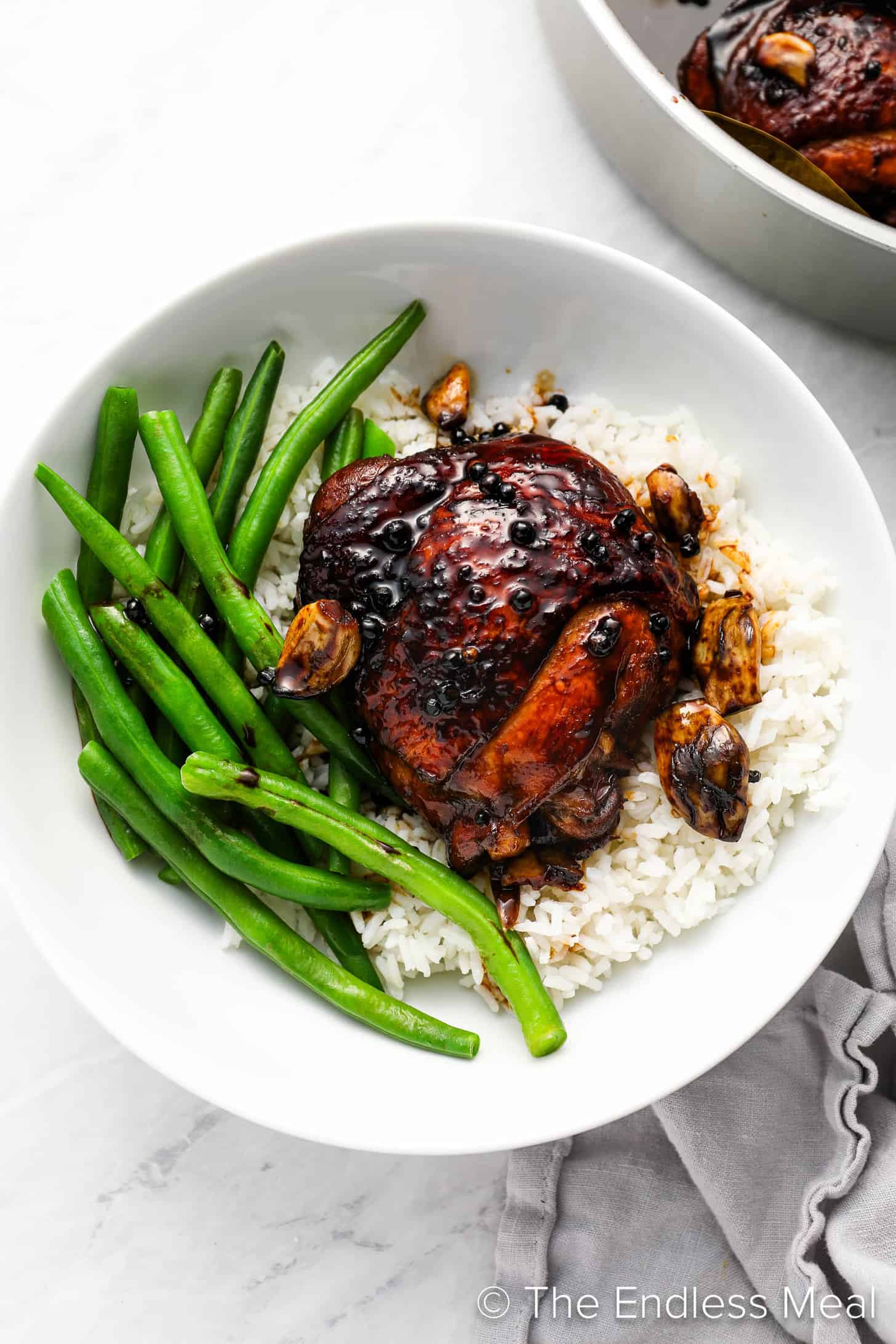
Both Gaile and Danielle told us that their mom, Ebie Guevara, served this recipe with steamed green beans. We think that our sauteed green beans with garlic go really well with chicken adobo!
Other greens that we’ve enjoyed with this recipe are sauteed bok choy and our garlic butter sugar snap peas .
And a rice dish is an almost mandatory side. Basmati rice is the easiest, but garlic butter rice or ginger rice are extra delicious.
And Danielle tells us that if you want to get fancy, garnish your chicken adobo with garlic chips! Yum!
Filipino Chicken Adobo – An Authentic Recipe
- Pin

Ingredients
- ▢ 1 cup soy sauce (see notes)
- ▢ ½ cup cane vinegar (or rice vinegar)
- ▢ ¼ cup brown sugar (optional)
- ▢ ¼ cup lemon juice (see notes)
- ▢ 16 cloves garlic (smashed with the side of your knife – see notes)
- ▢ 4 bay leaves
- ▢ 1 tablespoon whole black peppercorns (or 1 teaspoon ground pepper)
- ▢ 2 lb bone-in chicken thighs (see notes)
- ▢ 2 tablespoons cooking oil
Instructions
- Mix the soy sauce, vinegar, brown sugar if using, lemon juice juice, garlic, bay leaves, and black pepper in a baking dish. Add the chicken pieces and mix them around so that the chicken is well coated with the marinade. Cover the dish and put it into your fridge for 30 minutes to 24 hours to marinate. ¼ cup lemon juice, 1 cup soy sauce, ½ cup cane vinegar, 16 cloves garlic, 4 bay leaves, 1 tablespoon whole black peppercorns, 2 lb bone-in chicken thighs, ¼ cup brown sugar
- Remove the chicken from the marinade (save the marinade!) and pat it dry with paper towels. Heat the oil in a large frying pan over medium heat and sear the chicken for 5-6 minutes on each side, until it is nicely browned. The chicken won’t be cooked at this point. 2 tablespoons cooking oil
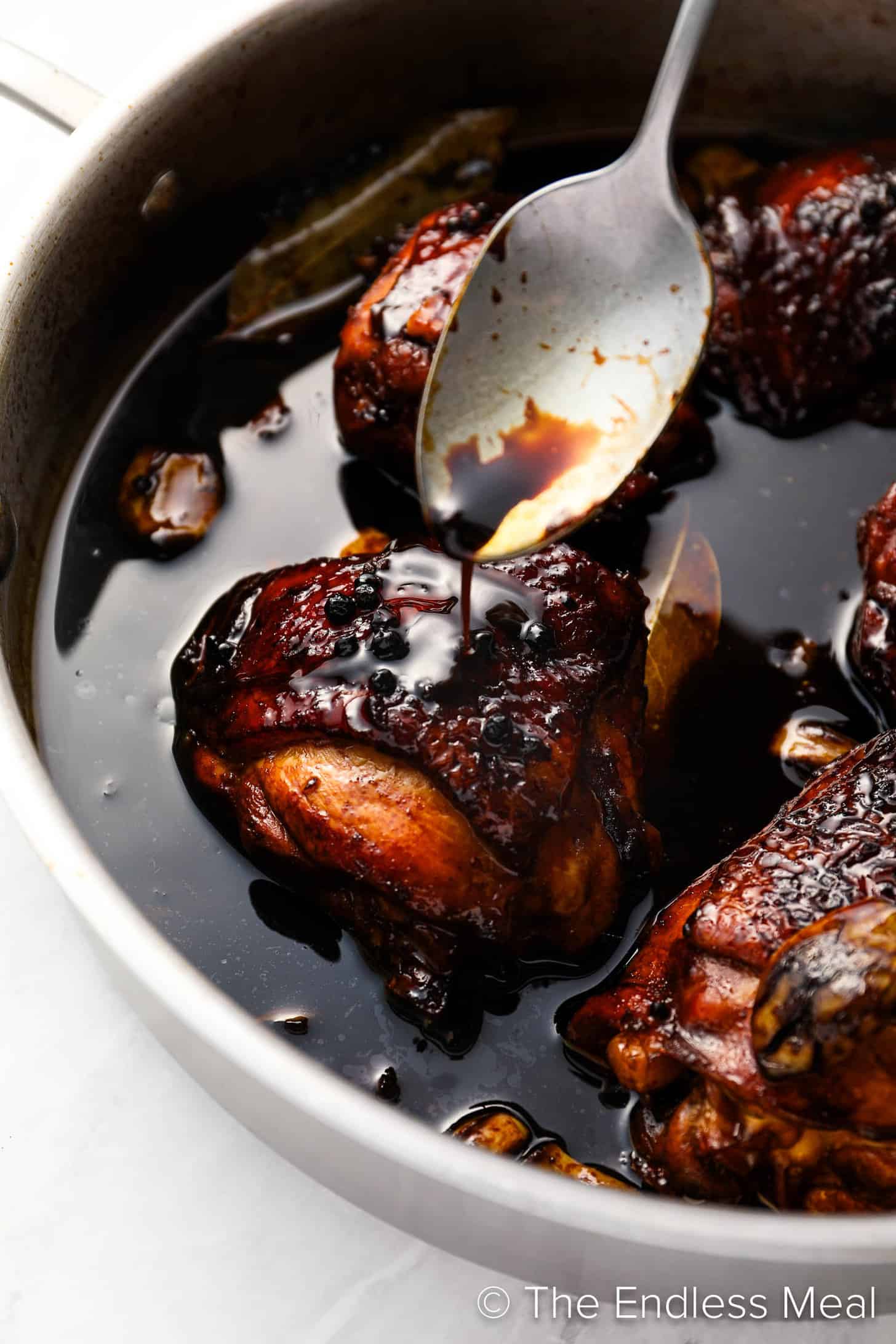
- Turn the chicken so that it is skin side facing up and then pour the reserved marinade into the pan. Bring to a boil and then reduce the heat to low, cover the pan, and let it simmer for 10 minutes. Uncover the pot and continue to simmer the chicken for another 5-10 minutes, until the chicken is tender and the sauce has reduced by half, stirring occasionally.
- Serve the chicken with some rice and lightly steamed greens on the side.
Video
Notes
Nutrition
We have thoroughly tested this recipe for accuracy. However, individual results may vary. See our full recipe disclosure here .
Did you make this?
We love to see what you made! Tag @theendlessmeal or hashtag #theendlessmeal !
What is Filipino adobo sauce made of?
Savory and subtly tangy adobo sauce is made from soy sauce, vinegar, garlic, peppercorns, and bay leaves.
Is Filipino adobo the same as Mexican adobo?
While they share a name, they are very different in terms of taste! Filipino adobo is very different than Mexican adobo. In Filipino adobo, the sauce is made largely from vinegar and soy sauce, so the flavor is strong and has a vinegary tang to it. On the other hand, Mexican adobo has a spicier touch and often makes use of oregano, cumin, and other spices that are blended into a thick, paste-like sauce.
Do I need to add sugar?
Danielle says that sugar is definitely optional. It will create a slightly sweeter version that tastes less acidic. We tested this recipe both with and without sugar and half of our recipe tasters liked it better with sugar and half liked it better without. If you tend to like sweeter chicken recipes or you’re worried about it being too acidic, go ahead and add the sugar.
The chicken is releasing water when it cooks, what should I do?
It’s normal for the cold meat to release some water when it starts warming up in the pan. It should just evaporate on its own, but you can also bring the chicken out of the fridge 30-60 minutes prior to cooking it. This allows it to start warming to room temperature.
Can I make Filipino adobo gluten-free?
Yes, just ensure you have a gluten-free soy sauce . It’s worth double-checking all the labels on the ingredients to make sure there are no additives containing gluten.
How do I store leftovers?
Store leftovers in the refrigerator in an airtight container for up to 3-4 days. You can also make a double batch and store some in a freezer-proof bag for up to three months, thawing it in the fridge the day before you want to enjoy it.
More Asian chicken recipes
For more inspiration, check out all of my dinner ideas !
Vietnamese Lemongrass Chicken
Glazed Hoisin Chicken Drumsticks
Korean BBQ Chicken
Sticky Chinese 5 Spice Chicken
Filipino Chicken Adobo - An Authentic Recipe
Ingredients
- 1 cup soy sauce , see notes
- ½ cup cane vinegar , or rice vinegar
- ¼ cup brown sugar , optional
- ¼ cup lemon juice , see notes
- 16 cloves garlic , smashed with the side of your knife - see notes
- 4 bay leaves
- 1 tablespoon whole black peppercorns , or 1 teaspoon ground pepper
- 2 lb bone-in chicken thighs , see notes
- 2 tablespoons cooking oil
Instructions
- Mix the soy sauce, vinegar, brown sugar if using, lemon juice juice, garlic, bay leaves, and black pepper in a baking dish. Add the chicken pieces and mix them around so that the chicken is well coated with the marinade. Cover the dish and put it into your fridge for 30 minutes to 24 hours to marinate. ¼ cup lemon juice, 1 cup soy sauce, ½ cup cane vinegar, 16 cloves garlic, 4 bay leaves, 1 tablespoon whole black peppercorns, 2 lb bone-in chicken thighs, ¼ cup brown sugar
- Remove the chicken from the marinade (save the marinade!) and pat it dry with paper towels. Heat the oil in a large frying pan over medium heat and sear the chicken for 5-6 minutes on each side, until it is nicely browned. The chicken won’t be cooked at this point. 2 tablespoons cooking oil
- Turn the chicken so that it is skin side facing up and then pour the reserved marinade into the pan. Bring to a boil and then reduce the heat to low, cover the pan, and let it simmer for 10 minutes. Uncover the pot and continue to simmer the chicken for another 5-10 minutes, until the chicken is tender and the sauce has reduced by half, stirring occasionally.
- Serve the chicken with some rice and lightly steamed greens on the side.
